
Swarmers in your house: flying ants or termites?
Every spring, ant swarmers and termite swarmers fly across Bradenton and Sarasota, and some end up inside by the windows and lights. Most people only notice the little piles of wings they leave behind. Here’s how to tell them apart in a minute, and what to do next.
Inspection firstthen a price for your home. No guessing.
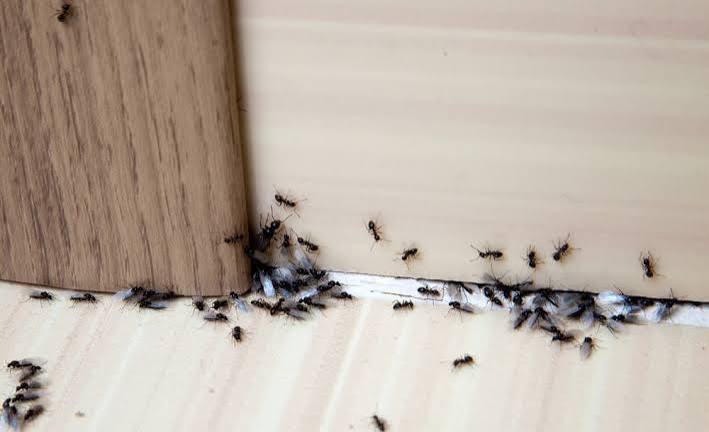
Flying ant or termite swarmer?
Get close (a phone photo zoomed in works). These four things give it away.
| Termite swarmer | Flying ant | |
|---|---|---|
| Antennae | Straight, like a string of beads | Bent at an elbow |
| Waist | Thick, no pinch | Thin and pinched |
| Wings | Four wings, all the same length, longer than the body | Four wings, the front pair longer than the back |
| Dropped wings | Yes, easily. Piles of wings are a classic sign. | Sometimes, but rarely in piles |
When termites swarm in Florida
Swarm time depends on the kind of termite, which is a useful clue.
Subterranean termites
Usually late winter and spring, often in the daytime after a warm rain.
Formosan termites
At dusk, roughly April to June, in big swarms drawn to lights.
Drywood termites
In the evening, often from spring into fall, and also drawn to lights.
Other termite signs to look for
Mud tubes
Pencil-wide dirt tunnels on the foundation, slab edges, piers or inside walls. Subterranean termites travel in them.
Piles of “sand” on the windowsill
Tiny, hard pellets piling up on sills, floors or under wood. These are drywood termite droppings, called frass.
Tiny holes in wood
Small round holes where drywood termites push their droppings out.
Bubbling paint, hollow wood
Paint that blisters, or wood that sounds hollow when you tap it.
What to do right now
Swarmers in the house look alarming, but they don’t bite, sting or eat wood. This is all you need to do.
Turn off the lights near them
Many swarmers fly toward light. Lights off near the swarm and they settle down.
Save a few
Put some swarmers or wings in a zip bag, or stick them to tape. It helps us tell ants from termites.
Vacuum up the rest
Swarmers die off on their own within a day or so. Don’t spray into walls or tear into wood; the colony that sent them is what matters.
Book an inspection
We find where they’re coming from and give you a price before any treatment.
Termite swarmer questions
Ask Pete anything else, day or night, in English or Spanish.
Are ant swarmers a problem?
Flying ants inside usually mean an ant colony nearby, often in a wall, under the slab or in a potted plant. They don’t eat wood, though carpenter ants nest in damp or damaged wood. Ants are covered by our pest treatment: $125 one-time or $475 a year for the quarterly plan.
Do swarmers mean I have termites?
Swarmers inside, especially piles of wings near windows, doors and lights, usually mean a colony is in or under the home. Swarmers outside mean termites are nearby. Either way, it’s a good time for an inspection.
Are termite swarmers dangerous?
They don’t bite or sting, and swarmers don’t eat wood themselves. They’re a sign of a colony that does.
How long does a termite swarm last?
Usually less than an hour. Swarmers that end up indoors die within a day or so because they can’t reach soil or water.
Do you do WDO inspections for home sales?
Yes. We do termite and wood-destroying organism (WDO) inspections for realtors and mortgage companies. See termite control.
More guides
Termite control
Inspections, spot-treatment injections, Sentricon and WDO inspections.
Florida ants
Ghost ants, white-footed ants, fire ants and more, side by side.
Palmetto bugs
Why big roaches show up after rain, and how to keep them out.
Ready when you are.
Pick an open weekday and arrival window online, or text us at 941-896-2852 for the fastest reply, Monday to Friday, 8am to 4pm.
-
Swarmers in the house?Not sure if they’re ants or termites? We’ll find out.
Termite inspection Quote